IIT Bombay's SemiX Summit Highlights GaN Power Devices, Semiconductor Startups and Energy-Efficient AI Hardware
The fourth annual SemiX IIT Bombay Summit brought together semiconductor researchers, startups, and industry participants to discuss GaN power devices, advanced packaging, neuromorphic computing, semiconductor entrepreneurship, and energy-efficient AI hardware.
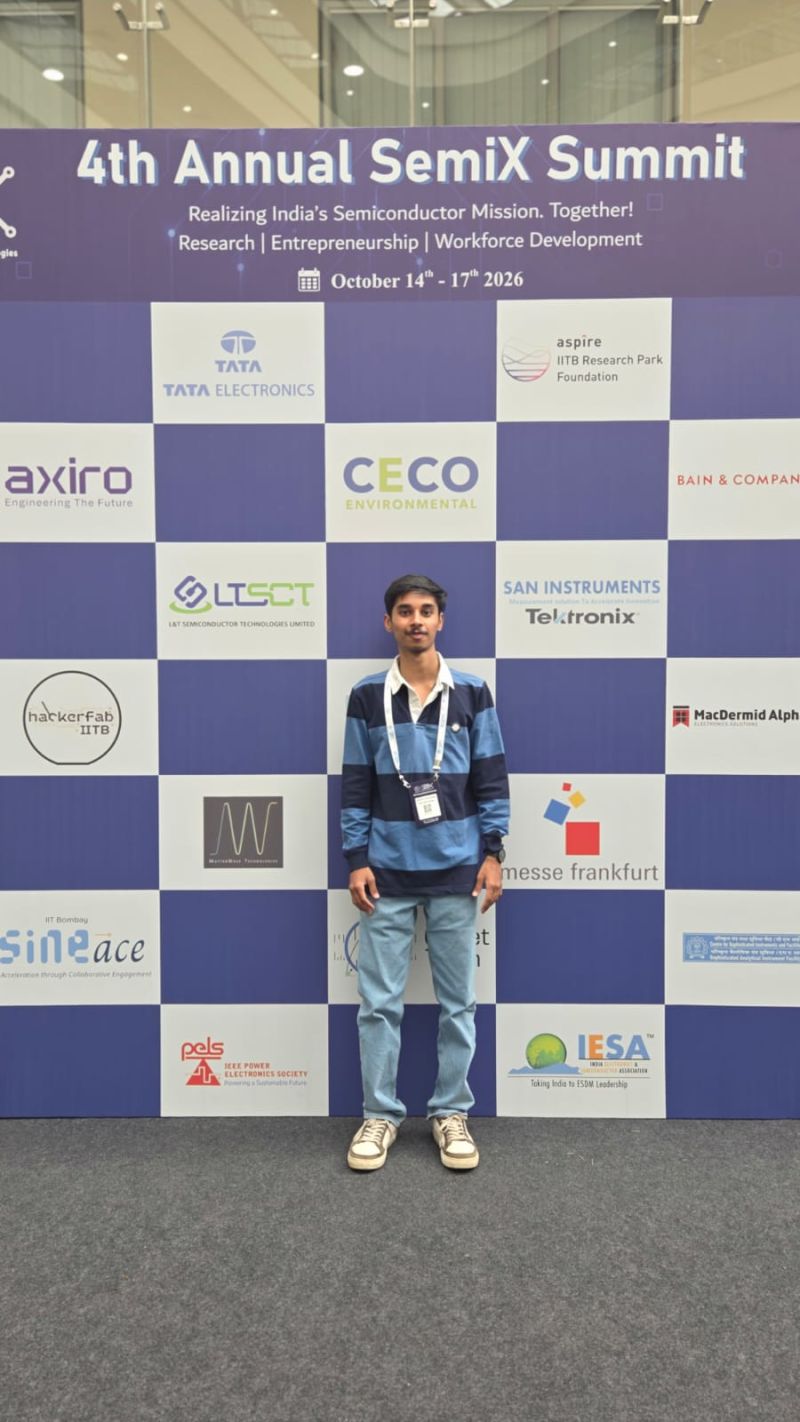
The fourth annual SemiX IIT Bombay Summit, held from October 14–17, 2026, highlighted developments in semiconductor research, chip design entrepreneurship, advanced packaging, and emerging hardware technologies.
The event included technical discussions and startup-focused sessions at IIT Bombay, including activities at the Convocation Hall and the ASPIRE IITB Research Park Foundation.
According to a LinkedIn account shared by VLSI student Aniket Kulkarni, the summit reflected the growing connection between academic semiconductor research and India's startup ecosystem.
One of the major themes was the transition from laboratory research to semiconductor commercialization.
Prof. Swaroop Ganguly discussed SemiX research areas including gallium nitride (GaN) power devices, advanced flip-chip packaging, and neuromorphic computing.
GaN semiconductor technologies are attracting attention because of their potential applications in high-efficiency power conversion and high-frequency electronics.
For RF and microwave engineers, GaN is also an important semiconductor material used in high-power RF amplifier technologies.
Advanced semiconductor packaging is another critical area because modern chip performance depends not only on transistor-level design but also on electrical interconnections, thermal management, and integration.
Flip-chip packaging enables semiconductor devices to connect to substrates through distributed electrical contacts, supporting compact and high-density electronic assemblies.
The summit also addressed the semiconductor entrepreneurship lifecycle, including the progression from proof-of-concept development to incubation, chip tapeout, and commercial scaling.
Sessions involving*Vijay Parmar, Kiran Deshpande, Akhilesh B., and Jayshree Nayak discussed challenges associated with building semiconductor companies.
Startup case studies mentioned in the participant's account included AmmSemi, MatterWave, Relsym Solutions Pvt. Ltd., Sampige Semiconductors, and Axiro Semiconductor.
The discussions illustrated the range of activities required to convert semiconductor research into commercial products.
Another recurring theme was the growing importance of energy-efficient AI computing and wide-bandgap power electronics.
The participant's summary referenced discussions involving organizations including Tata Electronics, Intel, Seagate Technology, and Applied Materials.
AI hardware development creates increasing demand for efficient processing, memory technologies, power management, and advanced semiconductor packaging.
At the same time, wide-bandgap materials such as GaN are becoming relevant to applications requiring improved power efficiency and high-frequency operation.
For India's semiconductor ecosystem, the summit highlighted the importance of connecting research institutions, engineering talent, startups, and established technology companies.
The event reflects ongoing efforts to strengthen domestic capabilities across semiconductor design, packaging, device technologies, and commercialization.
❤️ Share this news if you are proud to see Indian research institutions and semiconductor startups working together to build advanced chip technologies!