Dhruva Space Engages Defence Leaders in Hyderabad on Satellite Intelligence and National Security
Dhruva Space engaged participants of the Higher Defence Management Course at the College of Defence Management in Hyderabad, discussing satellite systems, geospatial intelligence, commercial satellite imagery, and private-sector contributions to national security.
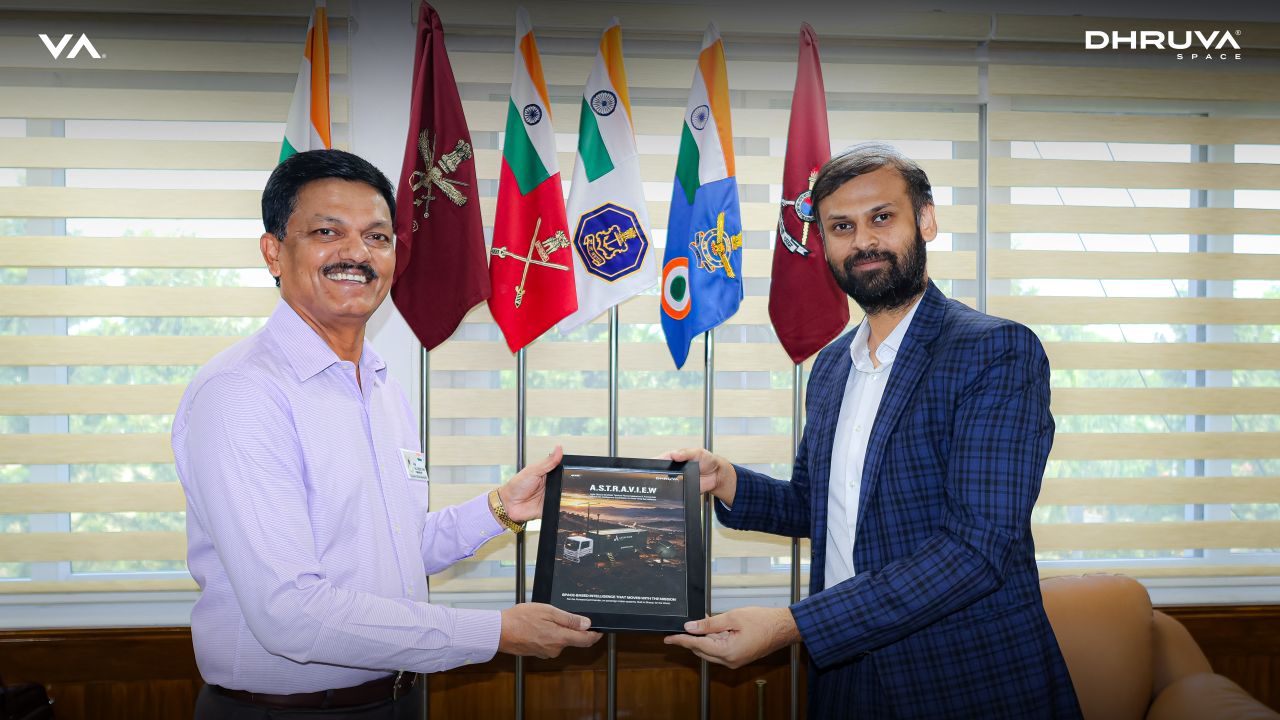
Hyderabad-based Dhruva Space has engaged with participants of the Higher Defence Management Course at the College of Defence Management (CDM), Hyderabad, highlighting the growing role of private space technology companies in India's defence and national security ecosystem.
The engagement focused on satellite systems, geospatial technologies, project management, and the integration of space-based intelligence into defence operations.
The discussions provided perspectives relevant to military leadership, including capability development, resource allocation, technology acquisition, and force modernization.
Krishna Teja Penamakuru, COO and Co-founder of Dhruva Space, discussed the evolving Indian space sector and the role of private industry in strengthening national security capabilities.
India's private space ecosystem has expanded into areas including satellite manufacturing, launch services, ground infrastructure, Earth observation, and satellite communications.
These capabilities are increasingly relevant to defence applications requiring reliable communication, situational awareness, and access to geospatial information.
During the engagement, Col Rajneesh Ralli (Retd), Vice President – Growth Operations, and Maj Chirayu Joshi (Retd), Senior Director – Integrated Security & Technology, discussed AstraView: Commercial Satellite Imagery.
They also highlighted the recently unveiled A.S.T.R.A.V.I.E.W command post, demonstrating how space-based intelligence can support actionable insights at the tactical level.
Satellite imagery can assist defence organizations with surveillance, terrain assessment, infrastructure monitoring, and operational planning.
Depending on the satellite payload and mission requirements, Earth observation systems may use optical imaging, synthetic aperture radar, or other remote-sensing technologies.
For RF and microwave engineers, satellite intelligence systems depend on several critical technologies, including RF payloads, satellite communication links, antennas, ground stations, and high-frequency electronic subsystems.
Reliable satellite-to-ground communication is essential for transferring mission data and supporting operational requirements.
Wg. Cmdr. Ashish Pathak (Retd), Associate Director – Portfolio Management, discussed project management across planning and execution.
Suhas Lakkundi, Business Development Manager, presented an overview of Dhruva Space's capabilities and their relevance to strategic and operational requirements.
The engagement highlights the importance of collaboration between private space companies and defence institutions as India develops indigenous space technologies.
It also demonstrates how satellite engineering, geospatial intelligence, and system integration are becoming increasingly connected to defence decision-making.
The announcement described an educational and industry engagement. It did not announce a new defence contract or procurement agreement.
❤️ Share this news if you are proud to see India's private space companies contributing to indigenous defence technology and satellite intelligence capabilities!