Japan’s Semiconductor Industry Expands Presence in India as Chip Ecosystem Grows
Japanese semiconductor companies are expanding their presence in India through investments, technology partnerships, equipment supply and workforce development as the country builds a domestic chip manufacturing ecosystem.
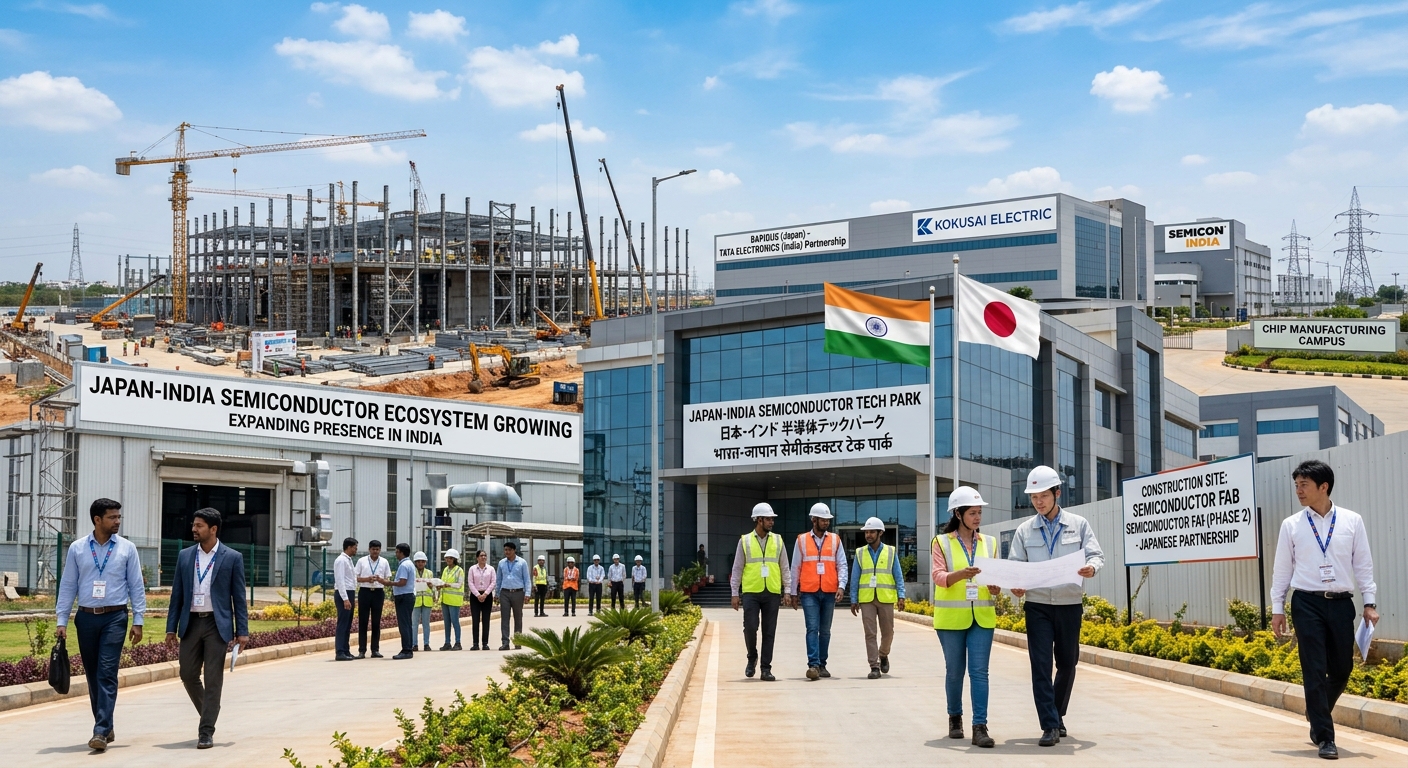
Japanese semiconductor and chip-equipment companies are increasing their engagement with India as the country accelerates efforts to establish a complete semiconductor ecosystem spanning materials, design, fabrication, packaging and testing. More than 30 Japanese companies participated in SEMICON India 2026 in New Delhi, where Indian and Japanese industry representatives discussed technology partnerships, resilient supply chains and research and development.
The growing cooperation follows stronger strategic ties between India and Japan in semiconductors and other advanced technologies. Under the first phase of India’s semiconductor programme, 12 manufacturing and packaging projects were approved, while the government is now moving towards a second phase with increased funding. India and Japan have also outlined broader industrial cooperation, with Japanese companies signing around 120 memorandums of cooperation involving investments of about 2 trillion yen.
Japanese companies are already becoming part of India’s emerging semiconductor supply chain. Fujifilm has agreed to develop and supply advanced semiconductor materials for Tata Electronics, while Sumitomo Chemical is considering a semiconductor materials supply-chain partnership with the company. Enomoto is expected to provide production technology support, and Tokyo Electron plans to establish a training centre in Gujarat in 2027 to develop engineers specialising in semiconductor manufacturing equipment.
The expansion reflects complementary strengths between the two countries, with Japan bringing expertise in semiconductor materials, manufacturing equipment and precision engineering, while India offers a large engineering talent base, growing electronics manufacturing capacity and domestic demand. However, shortages of specialised semiconductor skills and suppliers remain challenges. The increasing participation of Japanese companies could support technology transfer, workforce development and the creation of a more resilient domestic semiconductor supply chain in India.